
Difference Between Finance and Accounting: A Simple Guide for Students, Professionals, and Business Owners
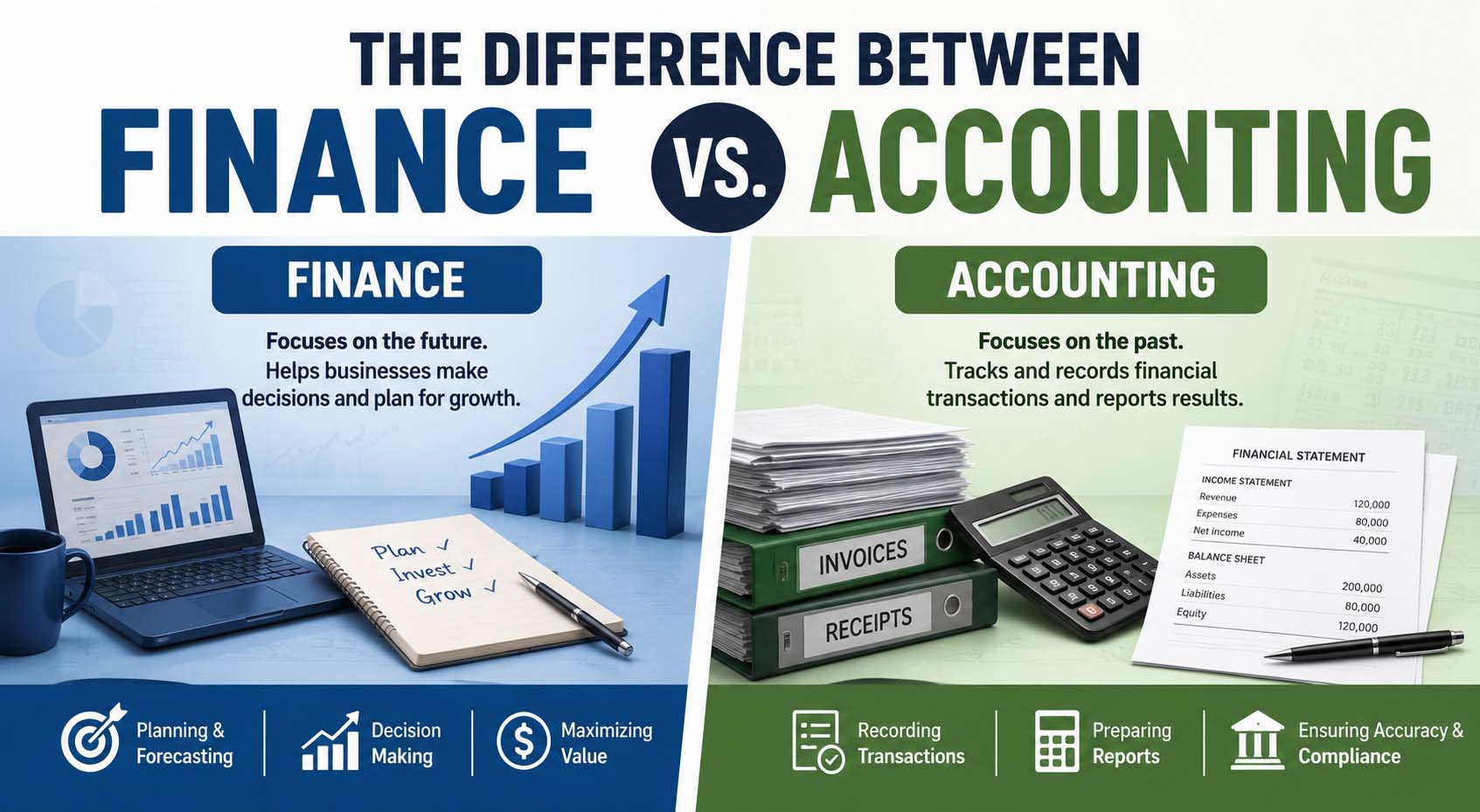
If you’ve ever wondered about the difference between finance and accounting, you’re not alone. The two fields are closely connected, and many people use the terms interchangeably. In reality, they serve different purposes within a business. Accounting focuses on recording and reporting financial information, while finance uses that information to plan, invest, and make strategic decisions.
Understanding how these disciplines work together can help you choose the right career, manage a business more effectively, or simply gain confidence when reading financial reports.
Difference Between Finance and Accounting Explained
The easiest way to understand the difference between finance and accounting is to think about time.
- Accounting mainly looks at what has already happened.
- Finance focuses on what should happen next.
Accountants organize financial records, prepare reports, and ensure compliance with regulations.
Finance professionals analyze those reports to make decisions about budgeting, investments, funding, and long-term growth.
Both departments rely on each other, yet their goals are different.
What Is Accounting?
Accounting is the process of recording, organizing, summarizing, and reporting financial transactions.
Its primary responsibilities include:
- Recording daily transactions
- Preparing financial statements
- Managing tax records
- Monitoring expenses
- Maintaining accurate books
- Supporting audits
For example, inventory valuation methods affect financial reporting. If you’re learning inventory accounting, understanding What Is FIFO provides a useful foundation for how businesses calculate inventory costs.
What Is Finance?
Finance focuses on managing money to help individuals and organizations achieve their financial goals.
Typical finance responsibilities include:
- Budget planning
- Investment analysis
- Cash flow management
- Risk assessment
- Business valuation
- Financial forecasting
Instead of documenting transactions, finance professionals analyze data to improve future performance.
Difference Between Accounting and Finance at a Glance
| Feature | Accounting | Finance |
|---|---|---|
| Primary Focus | Recording financial activity | Managing future financial decisions |
| Time Perspective | Past and present | Present and future |
| Main Goal | Accuracy and compliance | Growth and profitability |
| Typical Reports | Income statement, balance sheet | Budgets, forecasts, investment analysis |
| Key Skills | Attention to detail | Strategic thinking |
| Daily Work | Bookkeeping and reporting | Planning and financial analysis |
This comparison answers one of the most common questions people ask about the difference between accounting and finance.
How Accounting and Finance Work Together
Although they have different responsibilities, neither department can function effectively without the other.
Accounting provides reliable financial data.
Finance transforms that data into business decisions.
Imagine a company planning to expand into a new market.
The accounting team prepares financial statements showing current profits, expenses, and available cash.
The finance team then uses that information to determine whether expansion is affordable and likely to generate a positive return.
Real-World Business Example
Suppose a manufacturing company earns $5 million in annual revenue.
The accounting department would:
- Record every sale
- Track payroll
- Prepare tax documents
- Produce monthly financial statements
Meanwhile, the finance department would:
- Evaluate expansion opportunities
- Forecast next year’s revenue
- Analyze borrowing options
- Recommend investment strategies
Together, both teams support informed decision-making.
What Is the Difference Between Finance and Accounting in Small Businesses?
In smaller companies, one person may perform both accounting and finance tasks.
For example, a business owner might:
- Record invoices
- Pay suppliers
- Create budgets
- Forecast future sales
As the business grows, these responsibilities usually become separate positions.
This division improves accuracy while allowing more strategic financial planning.
Common Responsibilities Compared
Accounting Responsibilities
- Bookkeeping
- Financial reporting
- Tax preparation
- Payroll management
- Accounts payable
- Accounts receivable
- Compliance
Finance Responsibilities
- Budget creation
- Investment planning
- Financial modeling
- Capital allocation
- Cash management
- Risk management
- Business forecasting
Although some responsibilities overlap, each discipline has its own priorities.
Skills Needed in Each Career
Accounting Skills
Successful accountants typically develop:
- Strong organization
- Numerical accuracy
- Knowledge of accounting standards
- Spreadsheet proficiency
- Attention to detail
Finance Skills
Finance professionals often rely on:
- Analytical thinking
- Business strategy
- Forecasting
- Data interpretation
- Decision-making
- Communication
Both careers require solid mathematical skills, although finance generally involves more forecasting and strategic analysis.
Industries That Need Both Finance and Accounting
Nearly every organization depends on both functions.
Examples include:
- Banks
- Healthcare organizations
- Retail businesses
- Manufacturing companies
- Technology firms
- Government agencies
- Nonprofits
Even utility providers rely on accounting for accurate reporting and finance for long-term infrastructure planning. If you’re curious about that sector, our guide on What Are Utilities explains its role in the broader economy.
Career Opportunities
Popular Accounting Careers
- Accountant
- Auditor
- Tax Accountant
- Cost Accountant
- Payroll Specialist
- Controller
Popular Finance Careers
- Financial Analyst
- Investment Analyst
- Financial Planner
- Corporate Finance Manager
- Treasurer
- Portfolio Manager
Career growth in both fields remains strong because organizations always need professionals who understand money.
Education and Certifications
Accounting professionals commonly pursue certifications such as:
- CPA (Certified Public Accountant)
- CMA (Certified Management Accountant)
Finance professionals often pursue:
- CFA (Chartered Financial Analyst)
- CFP (Certified Financial Planner)
- FMVA (Financial Modeling & Valuation Analyst)
The best certification depends on your career goals rather than one being universally better.
Which Career Pays More?
Salary varies depending on experience, location, and industry.
In many cases:
- Entry-level accounting and finance salaries are fairly similar.
- Specialized finance roles may offer higher earning potential.
- Senior accountants and controllers can also earn excellent salaries.
Rather than choosing based solely on income, consider your interests and preferred working style.
Common Misunderstandings
Many beginners assume accounting and finance are identical.
Here are a few myths.
Myth: Finance Is Just Advanced Accounting
Not true.
Finance uses accounting information but focuses on planning and decision-making rather than recording transactions.
Myth: Accountants Only Do Taxes
Taxes are only one part of accounting.
Many accountants specialize in auditing, management accounting, financial reporting, or forensic accounting.
Myth: Finance Only Means Investing
Investment management is only one area of finance.
Corporate finance includes budgeting, capital structure, cash flow planning, and risk management.
Business Decisions That Use Both Fields
Successful companies combine accounting and finance when making major decisions.
Examples include:
- Purchasing equipment
- Expanding internationally
- Hiring new employees
- Launching new products
- Acquiring competitors
Similarly, purchasing departments rely on accurate financial information before negotiating contracts. Learning What Is Procurement helps illustrate how financial planning supports everyday business operations.
Finance vs. Accounting for Entrepreneurs
Business owners benefit from understanding both disciplines.
Accounting helps answer questions like:
- How much profit did we make?
- What expenses increased?
- Are our records accurate?
Finance answers questions such as:
- Can we afford another location?
- Should we borrow money?
- Which investment offers the best return?
Knowing both perspectives leads to better business decisions.
Where Finance and Accounting Meet Other Business Functions
Financial information doesn’t exist in isolation.
For instance, companies working with payment providers often need to understand What Is a Merchant, since merchant accounts and payment processing affect revenue recognition and cash flow.
Likewise, organizations raising capital or purchasing securities frequently work with professionals who understand What Is a Broker, especially during investment transactions or financial market activities.
These relationships show how finance and accounting connect with nearly every part of a business.
FAQs
What is the difference between accounting and finance?
Accounting focuses on recording and reporting financial information. Finance uses that information to plan investments, manage budgets, and support future business decisions.
What’s the difference between accounting and finance for students?
Students interested in organization, reporting, and compliance may enjoy accounting. Those who prefer forecasting, investing, and strategy often find finance more appealing.
Can someone work in both finance and accounting?
Yes. Many professionals begin in accounting before moving into finance, while others gain experience across both fields in smaller businesses.
Is finance harder than accounting?
Neither field is universally harder. Accounting emphasizes precision and rules, while finance focuses more on analysis, forecasting, and strategic thinking.
What is the difference between finance and accounting in a startup?
In startups, accounting keeps financial records accurate and compliant, while finance helps founders manage funding, cash flow, and growth planning.
Key Takeaways
Understanding the difference between finance and accounting makes it easier to choose a career, run a business, or interpret financial information with confidence. Accounting provides the reliable records that every organization depends on, while finance turns those numbers into plans for growth, investment, and long-term success.
Instead of viewing them as competing fields, think of them as complementary functions. Businesses perform best when accurate accounting supports smart financial decisions, allowing leaders to plan with confidence and adapt to new opportunities as they arise.